How Long Will Backwards Leadership Keep Us Trapped in 1922?
The Bureau of Reclamation’s new Final Environmental Impact Statement (FEIS) for the future of the Colorado River represents a massive missed opportunity for the seven Colorado River Basin states to partner in adapting to the 21st century.
This FEIS is meant to replace the old guidelines governing cuts to Colorado River allocations which expire in December. The 20-year-old, expiring Interim Guidelines dictated water cuts to the Lower Basin states of Nevada, California, Arizona, and Mexico based on Lake Mead’s water level. As Lake Mead dropped in elevation, these three states and Mexico had to take increasing cuts to their water supplies.
The old guidelines were established in 2007 as a stopgap solution to what at the time was thought to be a short-term drought. But as climate change science evolved in the hydrosphere, the use of the word “drought” in the American Southwest often just demonstrates ignorance of how mankind has impacted our water supplies with too many diversions and shrinking snowpacks from temperature increases. Rock-solid climate science demonstrates that the 25-year average of river flows in the Colorado River Basin are 22% lower than the 20th Century average. “Drought” doesn’t cut it anymore, especially since climate change is projected to worsen. Colorado River flows could shrink as low as 40% below the 20th century average in the coming years.
We have to embrace the reality that reduced flows are the new normal in the American West. Water leaders had 20 years to figure out how to equitably adapt to this harsh reality together, but they did not.
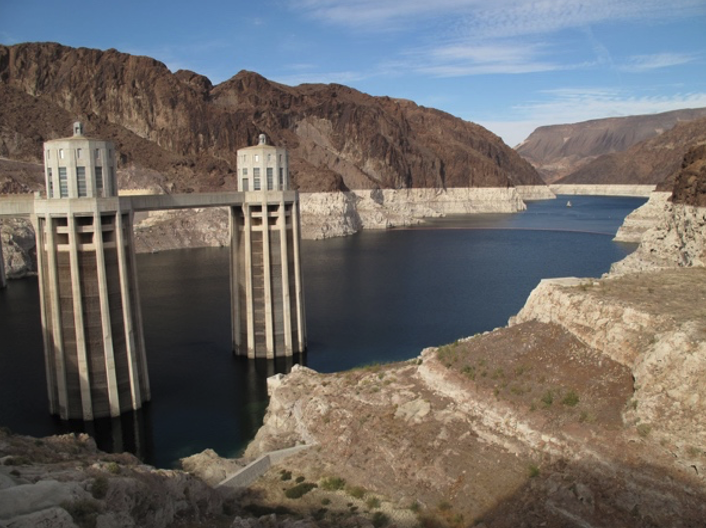
Lake Mead, the largest reservoir in the United States. Climate change and upstream diversions on the Colorado River have shrunk this reservoir down to a small fraction of its total capacity.
Lake Mead, the largest reservoir in the United States. Climate change and upstream diversions on the Colorado River have shrunk this reservoir down to a small fraction of its total capacity.
The proposed guidelines in the FEIS cling to archaic thinking and maintain an arbitrary line in the sand that divides a community of 40 million people in two for no logical reason other than it was done in a 104-year-old document — the 1922 Colorado River Compact. Dividing these states into two regions causes unfair treatment of some states while obscuring the waste of other states. For instance, the new plan penalizes Nevada with cuts for being in the Lower Basin, but Nevada already gets the smallest share of Colorado River water and runs exemplary water conservation programs.
The Bureau’s proposal would force 3.6-million-acre feet in water shortages to the Lower Basin states of California, Nevada, and Arizona during dry years, while merely calling on the Upper Basin states of Colorado, New Mexico, Wyoming, and Utah to voluntarily conserve up to 200,000-acre-feet. This meager, voluntary conservation goal represents roughly 5% of the Upper Basin’s Colorado River usage. This is a laughable water reduction goal since Utah is America’s most wasteful water user and could reduce its use by 20% without trying very hard.
But by thinking about the watershed as an us vs. them, Upper vs. Lower conflict, we fail to consider the people that live in other states and the Tribes that must get their water from state allocations. We aren’t thinking about how our communities use — or waste — water and how that waste impacts other communities. Despite having 20 years to negotiate a new paradigm, water leaders emerged with a stone age management philosophy for the Colorado River. So fresh.
This effectively means that the Lower Basin would bear the entire burden of climate change impacts while the Upper Basin can more or less keep pretending the climate is not changing, as many of its leaders have been doing for decades. Utah politicians can continue to bury their heads in the sands of climate change denial and advance new diversions of Colorado River water, like the Lake Powell Pipeline, the Green River Pipeline, and the Price River diversion. Utahns can remain the country’s most wasteful municipal water users since the FEIS fumbles the opportunity to pressure Upper Basin states to stop wasting Earth’s most precious resource.
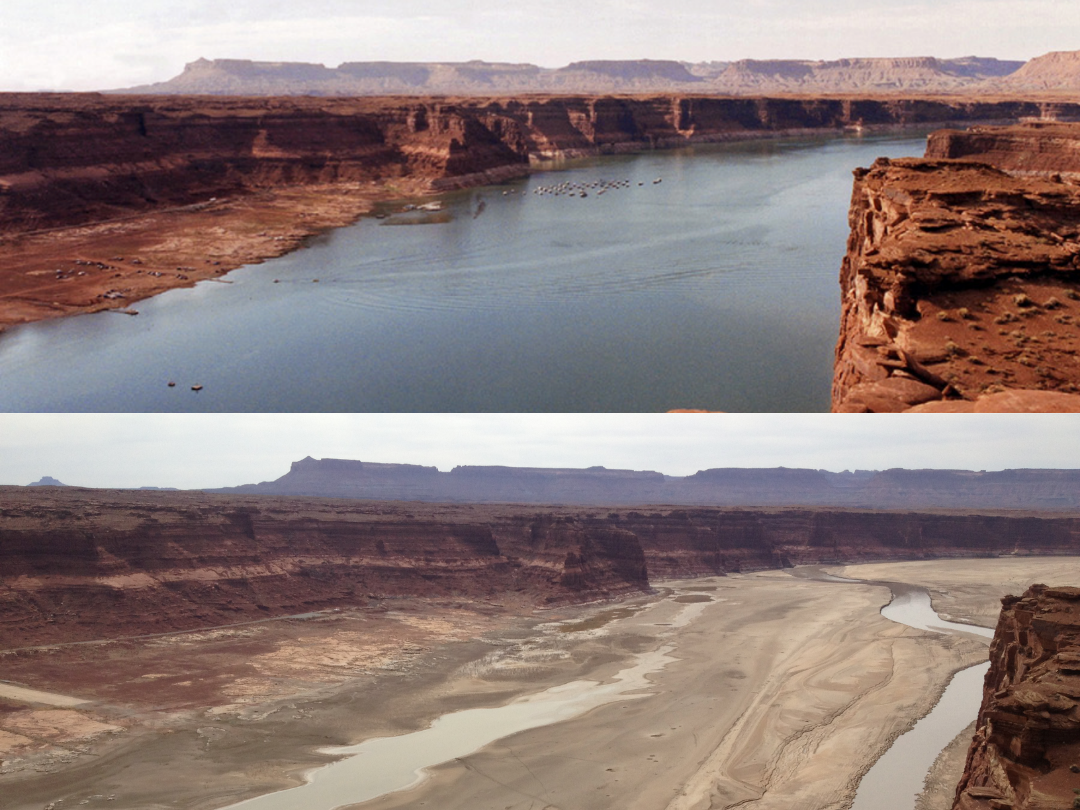
(Top) The Colorado River at Hite Bridge at the turn of the century; (Bottom) The Colorado River at the same spot roughly two decades later. “Drought” is a misnomer for the lasting impacts of climate change that we’re seeing on the Colorado River.
(Top) The Colorado River at Hite Bridge at the turn of the century; (Bottom) The Colorado River at the same spot roughly two decades later. “Drought” is a misnomer for the lasting impacts of climate change that we’re seeing on the Colorado River.
Negotiators from all seven basin states could have chosen to equitably manage the Colorado River as a shared resource. They could have decided to forego irresponsible new diversions. They could have abolished the artificial us vs. them divide separating the two basins. This new plan is the consequence of the failure of these water leaders to work together.
If these water leaders were elected officials, they could be voted out of office by constituents who suffer from their failures. Instead the public is stuck with appointed officials who never have to answer at the ballot box to those impacted by their decisions. We don’t know what is happening in these backroom conversations, so it could be simple obstinance, it could be the pull of special interests who benefit from new water diversions, it could be climate change ignorance, or some profane combination thereof. 40 million Americans are simply left without transparency, and we’re told that our water masters are all-knowing, all-powerful, and essentially perfect. It’s time to overhaul this process and make it more representative by sending in elected, not appointed, negotiators. It’s time to give the public some basic damn transparency.
Have transparency and good governance really become such a rare luxury in America?